Acidity Coefficient (Mk): A Key Differentiator Between Stone Wool and Slag Wool
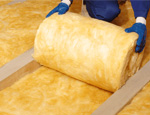
In industrial insulation applications, product performance is determined by the composition and durability of the insulation material. Bonded mineral wool insulation is a fibrous insulation material most commonly used in industrial applications. It is primarily composed of mineral oxides and falls under the IS 8183 standard in India. It is used for temperatures upto 800 deg C. Due to its mineral oxide content, it is non-combustible and with the right chemical composition, one can achieve health safety and EUCEB certification for the same.
The performance of such insulation depends on factors such as fiber quality, fiber packing with air entrapment, and long-term durability. One important parameter which influences the performance of industrial mineral wool insulation is the Acidity Coefficient (Mk).
Mk is the molar (or mass) ratio of acidic oxides to basic oxides present in the insulation fiber composition, excluding additives such as binders. As a result, it serves as an indicator of product quality and performance.
Acidity Coefficient (Mk) = (Sum of acidic oxides) ÷ (Sum of basic oxides)
Mk = (SiO₂ + Al₂O₃) / (CaO + MgO)
All oxides are expressed as a percentage by weight of the anhydrous fiber composition.
A higher Mk value contributes to the formation of finer and stronger fibers. These characteristics support improved thermal performance, higher mechanical strength, better moisture resistance, enhanced long-term durability and longer structural integrity under fire exposure.
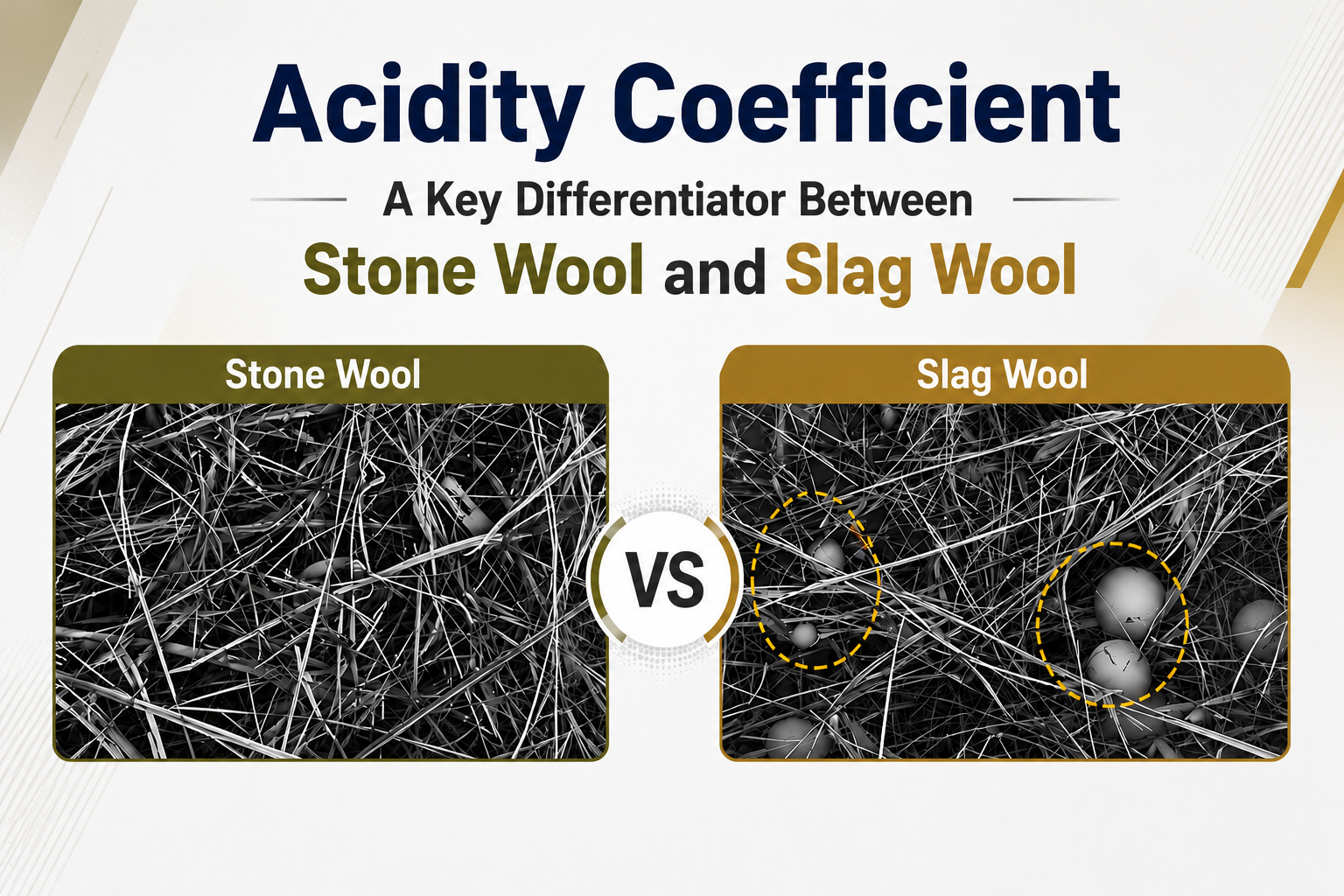
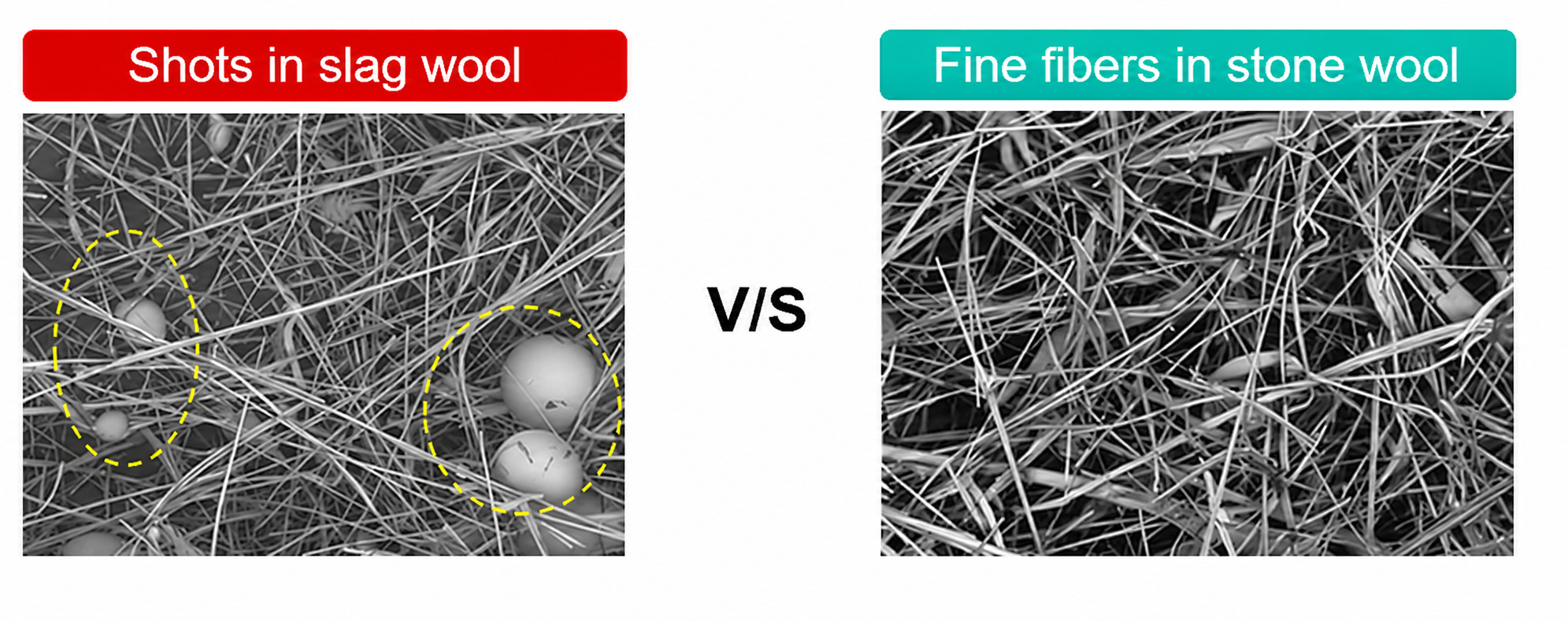
Conversely, insulation products with lower Mk values may exhibit coarser fibers, higher shot content, lower mechanical strength, and reduced resistance to moisture and corrosion under insulation (CUI). These factors can contribute to reduced energy efficiency, increased operating costs, and shorter service life in demanding industrial applications.
Mk therefore serves as an important indicator when evaluating mineral wool insulation, helping users distinguish between stone wool and slag wool products and make informed specification decisions.
Stone wool insulation typically exhibits an Mk ≥ 1.6, whereas slag wool insulation generally has an Mk value below 1.6.
Effect of Acidity Coefficient (Mk) on Product Performance
| Product Property | Stone Wool (Mk ≥ 1.6)  |
Slag Wool (Mk < 1.6)  |
Benefit of Higher Mk (Stone Wool)  |
|---|---|---|---|
| Fiber Diameter | ≤ 5 µm | > 7 µm | Higher surface area and improved thermal insulation |
| Fiber Length | Long, continuous | Short, irregular | Higher tensile strength |
| Shot Content | Low | High | Lower dead weight and better insulation performance |
| Fiber Uniformity | High | Low | More consistent product quality and performance |
| Mechanical Strength | Higher degree of polymerization | Lower | More crack resistant fiber cross-section, improved compressive strength, dimensional stability, resilience, and service life |
| Moisture Resistance | Excellent | Poor | Lower thermal conductivity, reduced maintenance, lower energy costs, and greater resistance to CUI |
| Corrosion Under Insulation (CUI) | Minimal | High | Longer equipment life |
| High-Temperature Process Stability | High | Low | Improved operational reliability |
| Fire Performance | Good | Poor | Better retention of structural integrity during fire exposure |
The above observations are based on testing conducted in a COFRAC-accredited laboratory (France). Both COFRAC and NABL accredit laboratories in accordance with the internationally recognized ISO/IEC 17025 standard, ensuring reliable, traceable, and globally accepted test results.
High-quality insulation enhances energy efficiency, reduces fuel consumption, lowers carbon emissions, and supports an organization’s sustainability goals.
Conclusion:
Acidity Coefficient (Mk) is an important indicator of mineral wool quality, influencing fiber fineness, strength, moisture resistance, thermal performance, CUI resistance, and long-term durability. A higher Mk, typically associated with stone wool, delivers more consistent and reliable performance in demanding industrial applications. Therefore, considering Mk during insulation specification can help improve asset integrity, energy efficiency, operational reliability, and overall lifecycle performance.
If you are looking to learn more or have a query about insulation solutions, feel free to reach out to us at sgindia.insulation@saint-gobain.com”.
Latest Blogs