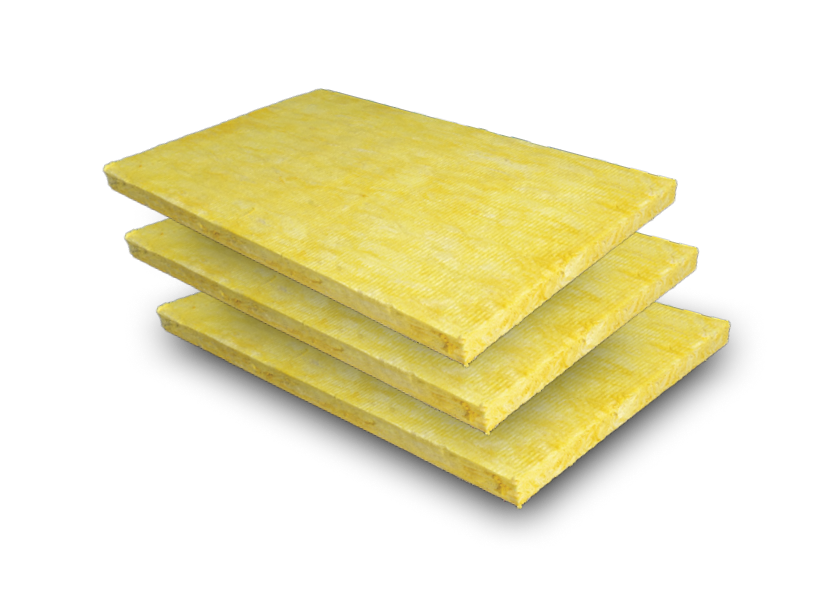

- Glass Wool
Glass Wool Board
-
 Rigid and
semi-rigid product
Rigid and
semi-rigid product
-
 Ease of
use
Ease of
use
-
 Customized sizes
-
Self Supported
Range
- Density : 32 to 120 kg/m3
- Thickness : 15 to 100 mm
- Width : 0.6 m
- Length : 1.2 m
- Available with or without facing
Facings
- Aluminium : FSK, R3035HD, Aluglass
- Polypropylene : White Metalized Polypropylene
- Tissue : FGT, BGT
- Glass Cloth : WGC, BGC
Basic Information
| Make / Brand | Twigainsul |
| Material | Resin bonded glass wool |
| Standard / Code | IS 8183 |
Product Performing Criteria
| Parameter | Values | Standards |
|---|---|---|
| Thermal Conductivity (W/m.K) |
0.030 to 0.034 at 25oC mean temperature | IS 8183, IS 3346 |
| Thermal Resistance at Specific Thickness
(m2 K/W) |
For 25 mm: 0.76 to 0.8 m2 K/W For 50 mm: 1.52 to 1.6 m2 K/W Calculated as per thickness and thermal conductivity of insulation |
|
| NRC | 0.65 to 0.95 | ASTM C-423 / ISO 354 |
General Material Properties
| Parameter | Values | Standards |
|---|---|---|
| Non-combustibility | Non-combustible / Incombustible, Reaction to Fire 'A1' | BS 476 Part 4, IS 8183, EN 13501 |
| Surface spread of flame | NIL, Class 1 | BS 476 part 7 |
| Fire propagation | Class 0, index l <12, sub-index i1 <6 | BS 476 part 6 and 7 |
| Moisture content | Less than 2% | IS 3144, IS 8183 |
| Shot content | NIL | IS 3144, IS 8183 |
| Sulphur / Chloride | Negligible | IS 3144, IS 8183 |
| Mold growth | None | IS 3144, IS 8183 |
| Alkalinity | pH 7 to 10 | IS 8183 |
Certifications and Approvals
| Environment | Fire | Health Safety | Standards Compliance |
|---|---|---|---|

|
|

|

|

|
|||

|

Frequently Asked Questions
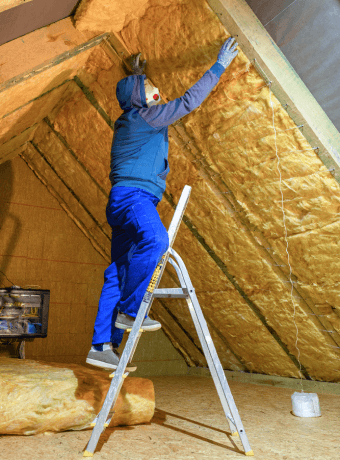
Glass wool board insulation is used for thermal, acoustic, and fire protection in walls, ceilings, HVAC ducts, and industrial equipment.
Glass wool boards have low thermal conductivity, offering high thermal resistance and effective heat transfer control. Crimped boards are stronger than normal boards and can be used as core of sandwich panels or base of membrane roofing where high compressive strength is required.
Yes, glass wool boards are non-combustible and comply with major fire safety and building standards.
Commercial construction, HVAC, manufacturing, cold storage, infrastructure, and OEM industries commonly use glass wool boards.
Glass wool boards offer excellent thermal and acoustic performance with lighter weight, while rock wool boards typically provide higher density and impact resistance.
Glass wool boards are available in multiple densities within a range of 32 – 120 Kg/m3 with several thicknesses to suit HVAC, wall, ceiling, and industrial insulation needs.
Yes, its fibrous structure effectively absorbs sound, reducing noise transmission and improving indoor acoustics.
Options include aluminum foil, polypropylene, black glass cloth, black tissue, and other facings based on application requirements.
Selection depends on thermal, acoustic, fire rating needs, system type, and applicable standards.
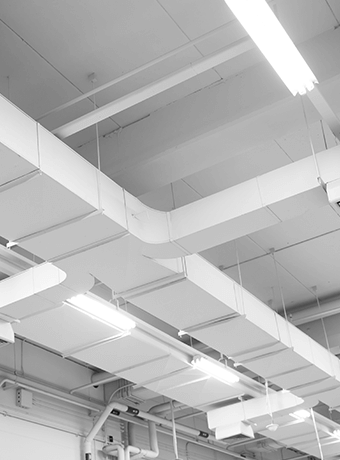
Yes, glass wool board is widely used for HVAC duct insulation due to its thermal efficiency, less compression, less sagging and noise control properties.
Engineers should consider density, thickness, facing type, fixing method, and vapor barrier requirements for optimal performance.